
Why the Best Leaders in 2026 Are No Longer Defined by One Leadership Style

In a world shaped by artificial intelligence, accelerated change, hybrid work, global uncertainty, and constant digital transformation, leadership is no longer about following a single management formula.
The most effective leaders today are not necessarily the most controlling, the fastest, the most flexible, or the most cost-driven.
Instead, the leaders creating the greatest impact in 2026 are those capable of adapting their leadership style according to:
- the business context,
- the maturity of their teams,
- the level of uncertainty,
- market pressure,
- technological disruption,
- and the increasing integration of Artificial Intelligence into everyday operations.
This shift is redefining what leadership means.
Modern leadership is becoming contextual.
The End of “One-Style Leadership”
For decades, organizations tried to define the “ideal leader.”
Some companies rewarded structure and control. Others prioritized execution speed. Some valued delegation and empowerment. Others focused heavily on operational efficiency and cost reduction.
But the reality is that every leadership style creates trade-offs.
A highly controlling leader may create operational stability — but can slow innovation. A speed-focused leader may generate momentum — but increase organizational risk. A flexibility-driven culture may encourage innovation — but lose accountability. A cost-driven approach may improve margins — but damage long-term scalability and retention.
The real challenge for modern leaders is not choosing one style.
It is understanding:
- when to use each style,
- when to shift,
- what is being gained,
- and what may unintentionally be sacrificed.
This is the foundation of contextual leadership.
The 5 Leadership Orientations Modern Organizations Commonly Use.
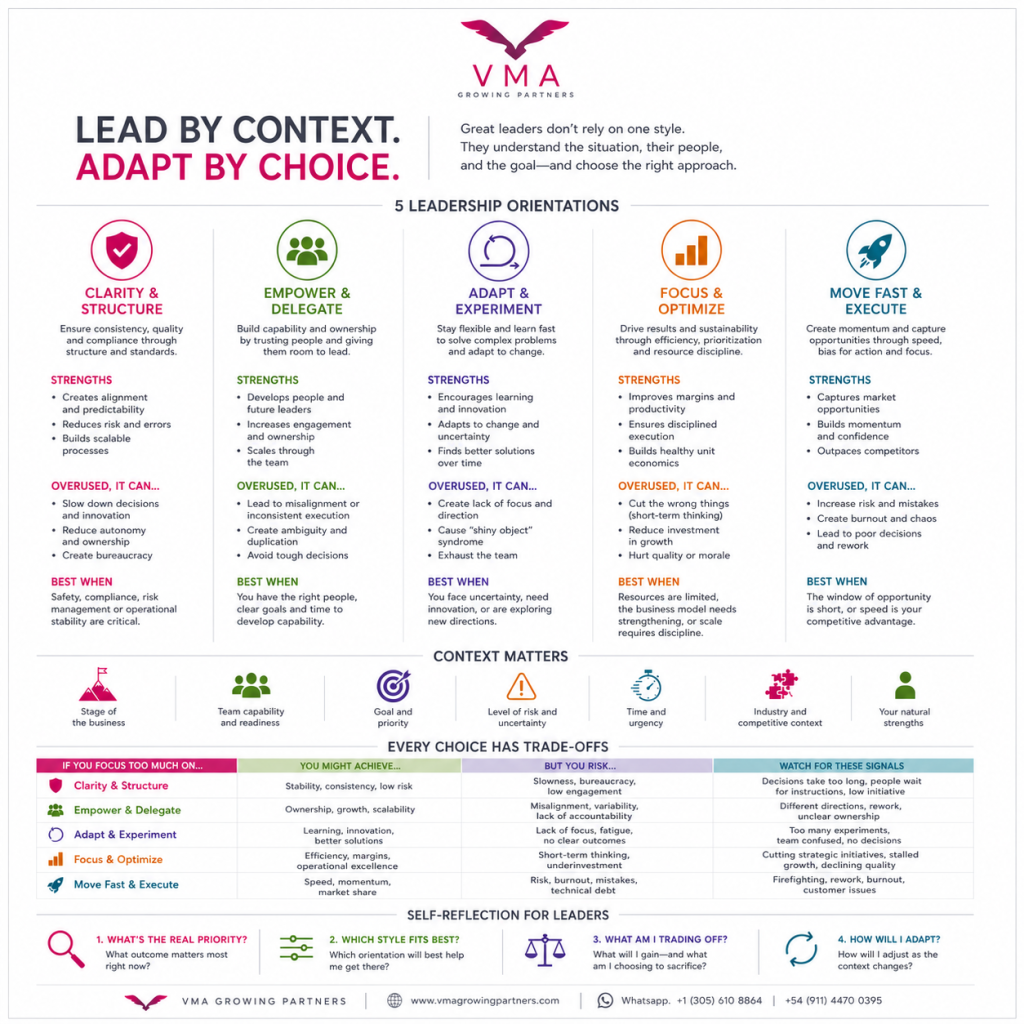
1. Clarity & Structure
This leadership orientation prioritizes:
- consistency,
- compliance,
- operational standards,
- predictability,
- and risk reduction.
It works especially well in:
- regulated industries,
- healthcare,
- finance,
- legal environments,
- and operationally critical organizations.
Strengths
- Creates alignment
- Reduces operational errors
- Builds scalable processes
- Improves visibility and governance
Risks When Overused
- Bureaucracy
- Slow decision-making
- Reduced ownership
- Innovation resistance
Modern organizations still need structure — but structure without adaptability becomes friction.
2. Empower & Delegate
This leadership approach focuses on:
- trust,
- empowerment,
- ownership,
- collaboration,
- and scalability through people.
It is highly effective in:
- growing organizations,
- high-performing teams,
- consulting firms,
- innovation environments,
- and leadership development cultures.
Strengths
- Develops future leaders
- Increases engagement
- Builds autonomy
- Supports scaling
Risks When Overused
- Misalignment
- Lack of accountability
- Ambiguous ownership
- Inconsistent execution
Delegation does not eliminate leadership responsibility. It changes the way accountability is managed.
3. Adapt & Experiment
This orientation thrives in:
- innovation,
- uncertainty,
- transformation,
- startups,
- and disruptive industries.
These leaders prioritize:
- learning,
- experimentation,
- agility,
- rapid adaptation,
- and flexibility.
Strengths
- Encourages innovation
- Helps organizations adapt quickly
- Creates learning cultures
- Improves problem-solving
Risks When Overused
- Lack of focus
- “Shiny object syndrome”
- Team fatigue
- Unclear priorities
Agility without structure often creates chaos.
4. Focus & Optimize
This style prioritizes:
- efficiency,
- productivity,
- operational discipline,
- margins,
- and sustainable execution.
It is especially valuable during:
- economic pressure,
- scaling phases,
- profitability optimization,
- operational restructuring,
- and cost-management initiatives.
Strengths
- Improves productivity
- Creates operational clarity
- Increases profitability
- Strengthens execution discipline
Risks When Overused
- Short-term thinking
- Underinvestment in talent
- Reduced innovation
- Burnout cultures
Leaders focused only on optimization often forget that people are not operational variables.
5. Move Fast & Execute
This orientation dominates:
- startups,
- hypergrowth companies,
- sales-driven organizations,
- and highly competitive environments.
These leaders prioritize:
- speed,
- momentum,
- action,
- market capture,
- and execution.
Strengths
- Accelerates opportunities
- Builds momentum
- Creates competitive advantage
- Encourages action-oriented cultures
Risks When Overused
- Burnout
- Operational mistakes
- Technical debt
- Poor decision quality
- Reactive management
Speed can create growth. But unmanaged speed creates hidden organizational risk.
Why Context Matters More Than Ever
One of the most important leadership trends in 2026 is the shift from static leadership models toward adaptive leadership.
The best leaders today understand that leadership decisions must change according to:
- business stage,
- team maturity,
- urgency,
- risk,
- competitive pressure,
- AI integration,
- and organizational readiness.
A startup may require speed. A healthcare organization may require structure. A transformation process may require experimentation. A scaling business may require optimization.
There is no universally correct leadership style.
There is only the most effective leadership response for a specific moment
The AI Revolution Is Redefining Leadership Expectations
Artificial Intelligence is not only transforming technology.
It is transforming:
- leadership,
- organizational structures,
- talent expectations,
- decision-making,
- communication,
- and the future of work itself.
Leaders are no longer expected to simply manage people.
They are increasingly expected to:
- orchestrate human + AI collaboration,
- redesign workflows,
- increase adaptability,
- improve digital literacy,
- and create cultures capable of continuous learning.
The arrival of AI is changing both:
- What leaders must do.
- What leaders expect from employees.
How Leadership Functions Are Changing Because of AI
1. Leaders Must Become Decision Architects
In the past, leaders were expected to provide answers.
Today, AI can generate:
- reports,
- data analysis,
- projections,
- operational recommendations,
- and strategic insights.
This means leaders now add value through:
- judgment,
- prioritization,
- ethical thinking,
- strategic interpretation,
- and contextual decision-making.
The future leader is not the person with the most information.
It is the person capable of interpreting complexity.
2. Leaders Must Develop AI-Augmented Teams
Organizations are increasingly expecting employees to:
- use AI tools effectively,
- automate repetitive tasks,
- increase productivity,
- improve communication,
- accelerate problem-solving,
- and adapt continuously.
As a result, leaders must:
- train teams in AI literacy,
- redesign workflows,
- define new performance expectations,
- and encourage responsible AI adoption.
AI is becoming a productivity multiplier.
But without leadership guidance, it can also create:
- misinformation,
- dependency,
- low-quality execution,
- and ethical risks.
3. Emotional Intelligence Is Becoming More Valuable — Not Less
As AI automates operational and analytical work, uniquely human capabilities become more important.
The leaders of the future will increasingly be evaluated by:
- empathy,
- communication,
- adaptability,
- influence,
- coaching ability,
- conflict resolution,
- and emotional intelligence.
The paradox of AI is that the more technology advances, the more human leadership matters.
4. Leaders Must Manage Continuous Change
The pace of transformation is accelerating.
Employees are navigating:
- AI disruption,
- role uncertainty,
- digital overload,
- remote work complexity,
- and continuous upskilling pressure.
Modern leaders must therefore become:
- communicators,
- facilitators of change,
- culture builders,
- and psychological safety creators.
The organizations that adapt fastest will not necessarily be the ones with the most technology.
They will be the ones with the most adaptable cultures.
What Organizations Will Expect from Employees in the AI Era
The AI revolution is also changing what companies value in talent.
Increasingly, organizations are prioritizing professionals capable of:
- learning continuously,
- adapting quickly,
- collaborating with AI,
- thinking strategically,
- solving complex problems,
- communicating effectively,
- and generating value beyond technical execution.
Employees are no longer evaluated only by what they know.
They are evaluated by:
- how quickly they learn,
- how they adapt,
- and how effectively they combine human judgment with technology.
This is one of the biggest shifts in modern employability.
Final Reflection: Leadership Is Becoming More Human, Not Less
One of the biggest misconceptions about AI is believing leadership will become more technical.
In reality, leadership is becoming:
- more adaptive,
- more strategic,
- more contextual,
- more collaborative,
- and more human.
The future belongs to leaders capable of balancing:
- structure and flexibility,
- speed and sustainability,
- efficiency and empathy,
- technology and human connection.
Because in the AI era, leadership is no longer about controlling people.
It is about helping people and organizations adapt intelligently to change.
Sources & Research References
This article integrates concepts, trends, and frameworks inspired by research and publications from:
- Harvard Business Review (Leadership in the Age of AI)
- McKinsey & Company (The State of AI Reports)
- Deloitte Human Capital Trends
- World Economic Forum – Future of Jobs Report
- MIT Sloan Management Review
- Gartner Leadership Vision Reports
- Google Cloud AI Workplace Studies
- Microsoft Work Trend Index
- Daniel Goleman – Emotional Intelligence Framework
- Paul Hersey & Ken Blanchard – Situational Leadership Theory
- Amy Edmondson – Psychological Safety Research
Additional inspiration and synthesis developed by: VMA Growing Partners www.vmagrowingpartners.com
At VMA Growing Partners, we specialize in self-awareness tools that support individuals in their personal and professional growth.
We partner with both companies and individuals throughout their transformation and growth processes, offering Search and Selection, Recruiting, Outplacement, Coaching, Assessment, and Training services.
Agus Sánchez
VMA Growing Partners
Strategic Advisory
agus@vmagrowingpartners.com
WhatsApp: +1 (786) 412 3967 / +54 (911) 5925 9911