
Why Do You Thrive in Some Environments and Shut Down in Others?
Take a moment to think about the people, teams, and environments that are part of your life.
Why do you feel confident, energized, and authentic around some people, while around others you become more reserved, hesitant, or distant?
Why are there meetings where your ideas flow naturally and others where you choose to remain silent?
Why do certain environments bring out the best in you, while others make you feel like you constantly have to prove your worth?
Most people assume these differences are caused entirely by external circumstances. However, there is a much deeper perspective to consider:
It’s not only about who you are. It’s also about who you become when you’re in relationship with others.
The Invisible Pattern Shaping Your Life
Every day, we participate in multiple relational systems:
- Our family
- Our partner or spouse
- Our friends
- Our leaders and managers
- Our clients
- Our teams
- Our communities
Although we often think we show up the same way everywhere, the reality is quite different.
Our emotional, mental, and relational systems continuously adapt to the environment around us.
Sometimes we expand.
Sometimes we contract.
Sometimes we perform.
And sometimes we withdraw.
The question is:
Are you aware of when and why these shifts occur?
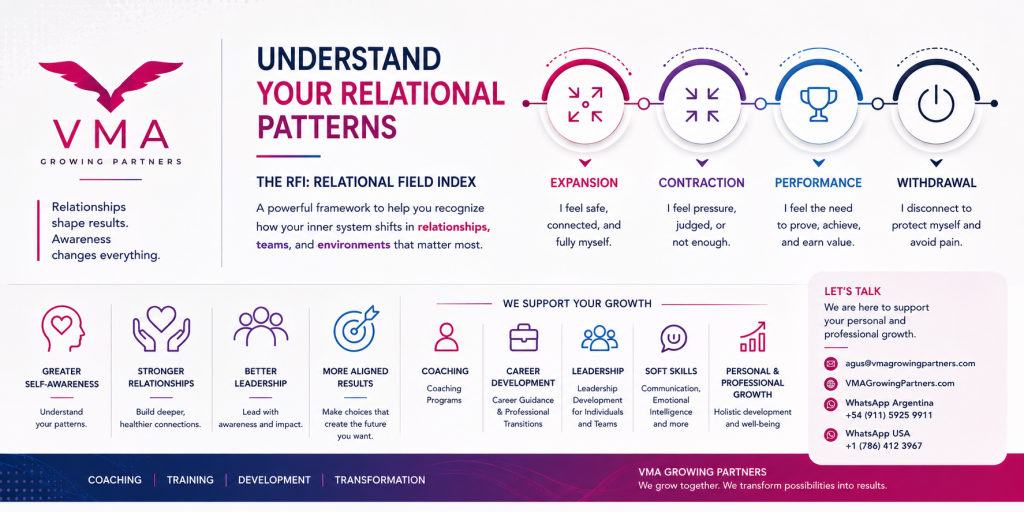
Introducing the RFI: Relational Field Index
The Relational Field Index (RFI) is a framework designed to help individuals understand how their internal system changes when interacting with the people and environments that matter most.
It is not designed to label you.
It is not intended to define who you are.
Instead, it helps you recognize how you respond within different relational contexts.
Because often, the challenge is not the situation itself.
The challenge is understanding how your system has learned to adapt in order to feel safe, valued, accepted, or connected.
The RFI identifies four core relational movements.
1. Expansion
Expansion occurs when we feel safe, confident, authentic, and fully engaged.
This is the state where we tend to access our best thinking, creativity, and leadership.
When we are in expansion:
- We share ideas freely.
- We feel heard and valued.
- We participate actively.
- We become more creative.
- We build meaningful connections.
- We experience greater energy and motivation.
People often describe these environments by saying:
“I can truly be myself here.”
Reflection
Where do you feel most alive, engaged, and authentically yourself?
Who are the people that bring out the best version of you?
2. Contraction
Contraction occurs when our system perceives judgment, pressure, uncertainty, or emotional risk.
As a result, we begin to protect ourselves.
When we are in contraction:
- We speak less.
- We second-guess ourselves.
- We self-censor.
- We avoid taking risks.
- We become less proactive.
- We experience tension and discomfort.
This does not necessarily mean the environment is unhealthy.
It simply means our internal system believes protection is required.
Reflection
Where in your life do you find yourself becoming smaller than you truly are?
3. Performance
Performance is one of the most common patterns among high achievers, professionals, entrepreneurs, and leaders.
It emerges when we believe we must constantly prove our value in order to be accepted, appreciated, or respected.
When operating from performance:
- We overwork.
- We struggle to establish boundaries.
- We seek approval.
- We become perfectionists.
- We tie our self-worth to achievement.
- We push ourselves relentlessly.
From the outside, performance often looks like excellence, dedication, and ambition.
Internally, however, it may be driven by fear, insecurity, or the need for validation.
Over time, it can lead to burnout, exhaustion, and disconnection.
Reflection
How much of what you do comes from genuine purpose, and how much comes from the need to prove that you are enough?
4. Withdrawal
Withdrawal occurs when our system decides to disconnect in order to protect itself.
This doesn’t always mean physically leaving a situation.
Often, we remain present while emotionally checking out.
When withdrawal occurs:
- We disengage.
- We lose motivation.
- We avoid difficult conversations.
- We isolate ourselves.
- We stop contributing.
- We reduce our emotional investment.
Withdrawal is often a silent form of self-protection.
Reflection
What relationships, situations, or environments are causing you to disconnect from yourself or others?
The Most Important Insight
One of the most powerful aspects of the RFI is that none of these movements are inherently good or bad.
Expansion is not “better” than contraction.
Performance is not “wrong.”
Withdrawal is not failure.
Each movement represents your system’s attempt to protect something important:
- Safety
- Belonging
- Recognition
- Love
- Autonomy
- Significance
- Security
- Connection
When we understand this, we stop judging ourselves.
And we begin to understand ourselves.
The Moment Everything Changes
Many people spend years blaming their environment.
They say:
- “My boss limits me.”
- “My team doesn’t listen to me.”
- “My partner doesn’t understand me.”
- “My family holds me back.”
And while circumstances certainly matter, there is a more powerful question:
How am I participating in this dynamic?
When our patterns become visible, a new possibility emerges.
The possibility of choice.
The choice to communicate differently.
The choice to lead differently.
The choice to establish healthier boundaries.
The choice to show up with greater awareness.
The choice to become intentional rather than reactive.
Because true growth doesn’t begin when circumstances change.
It begins when we develop the ability to observe ourselves with honesty and awareness.
The Most Important Leadership Skill Is Self-Leadership
People who develop relational intelligence do more than understand others.
They understand themselves.
They recognize:
- Where they expand.
- Where they contract.
- Where they seek validation.
- Where they disconnect.
- Which relationships fuel their growth.
- Which conversations they need to have.
- Which boundaries they need to establish.
- Which inner resources they need to strengthen.
As a result, they build healthier relationships, stronger leadership capabilities, more fulfilling careers, and lives that are more aligned with who they truly are.
Ready to Better Understand Your Relational Patterns?
At VMA Growing Partners, we believe that personal growth and professional growth are deeply interconnected.
We specialize in helping individuals, professionals, leaders, and teams develop greater self-awareness, emotional intelligence, leadership effectiveness, communication skills, and personal resilience.
Through our coaching programs, leadership development initiatives, professional growth workshops, and customized learning experiences, we help people identify the patterns that may be limiting their potential and develop new ways of thinking, leading, and relating.
Whether you are navigating a career transition, stepping into leadership, seeking greater fulfillment, improving team dynamics, or simply looking to understand yourself at a deeper level, we would be honored to support your journey.
Because the quality of your relationships ultimately shapes the quality of your life.
And sometimes, one meaningful conversation can become the starting point for a transformational breakthrough.
At VMA Growing Partners, we specialize in self-awareness tools that support individuals in their personal and professional growth.
We partner with both companies and individuals throughout their transformation and growth processes, offering Search and Selection, Recruiting, Outplacement, Coaching, Assessment, and Training services.
Agus Sánchez
Director | VMA Growing Partners
www.VMAGrowingPartners.com
agus@vmagrowingpartners.com
WhatsApp Argentina: +54 (911) 5925 9911
WhatsApp USA: +1 (786) 412 3967
VMA Growing Partners
Empowering Personal and Professional Growth Through Coaching, Learning, and Transformation.
—————————————————–